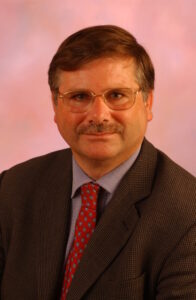
For our last lecture of 2025, we are really pleased to have Professor Mark Bailey MBE, Emeritus Director of Armagh Observatory back with us for our Christmas Lecture.
His talk is titled ‘Giant Comets and their impacts through time (the remarkable Comet Encke). It will take place in our usual venue at Ballyclare High School Lecture Theatre on Monday 1st December starting at 8pm sharp.
About the talk: Why comets have played such a prominent role in human affairs throughout history is a longstanding puzzle. This talk briefly introduces the subject of comets and their origin, emphasizing the relatively recent discovery of ‘giant’ comets, defined to be objects for which the cometary nucleus has a diameter greater than 50 km. This is more than five times the size of Halley’s comet, 25 times its surface area, and 125 times its mass. ‘Giants’ can range in size up to more than 250 km and occur in the long-period and time-variable short-period comet populations. They enter the inner solar system at frequencies of the order of one per 100,000 years. Such a comet would likely become the most prominent object in the sky other than the Sun and Moon, and debris from its evolution in the inner solar system could produce a much more ‘active’ sky than that experienced today. Evidence for the most recent ‘giant’, believed to be the progenitor of Comet Encke, suggests that this comet may have arrived in near-Earth space between 10 and 20 thousand years ago. If so, it might have provided (1) the inspiration for mankind’s early interest in the sky; (2) a trigger and explanation for people’s invention, fear, and worship of sky-gods; and (3) a motivation for the construction of megalithic monuments, with their evident calendrical and astronomical associations.
About The Speaker: Mark Bailey was director of Armagh Observatory from 1995 to 2016. He obtained his first degree in Physics at the University of Cambridge in 1974 and a Masters in Astronomy at the University of Sussex in 1975, completing his PhD on the evolution of active galactic nuclei at the University of Edinburgh in 1978. Subsequently, his principal interests moved towards areas closer to home: the origin and evolution of comets, asteroids and their associated meteoroid streams; solar system — Earth interrelationships; and the near-Earth object impact hazard. He is also interested in aspects of astronomical history, our changing weather, and in possible astronomical contributions to climate change.
We hope you can join us for our last lecture of 2025. Having Mark along is a great way to end the year. Since it’s also our Christmas lecture, join us after the meeting for a nice cup of tea or coffee and an early mince pie.
Clear Skies
NIAAS